VERIFIED
Explicit source-backed relationship in the stated scope. The scope may be exact replacement fit, component presence, collection-level accessory, or service capability—read the basis.
The four labels answer different evidence questions. They are not a quality score from “good” to “bad,” and they should never be collapsed into a single “fits” flag.
Compatibility methodology · Editorial policy
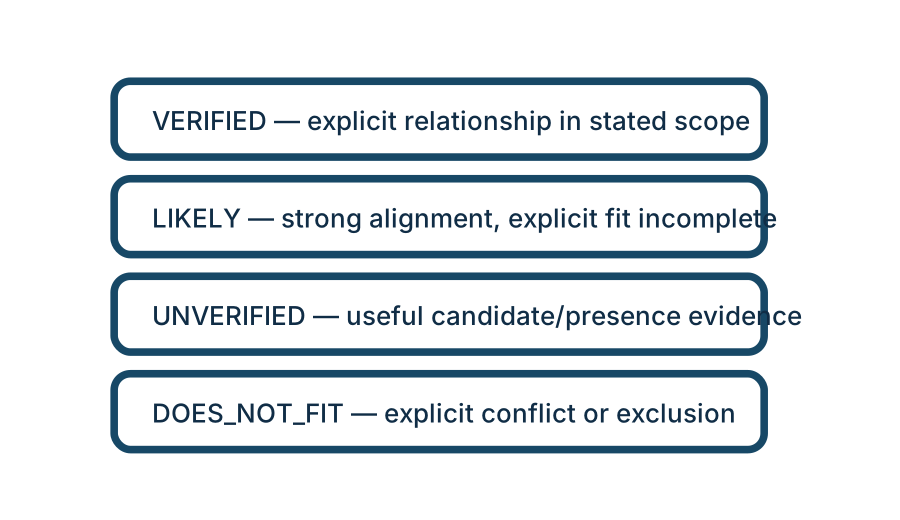
Explicit source-backed relationship in the stated scope. The scope may be exact replacement fit, component presence, collection-level accessory, or service capability—read the basis.
Strong alignment exists, but explicit authoritative fit is incomplete or provenance has a ceiling.
Candidate, catalog-presence, service-path or component-presence evidence may be useful, but exact replacement fit is not confirmed.
An explicit exclusion, wrong generation, wrong position, wrong size/interface or other conflict is preserved.
Manufacturer-backed SKU and @work production scope.
What it proves: The stated OEM relationship.
What it does not prove: VERIFIED still applies only to the published scope, not every Briggs & Riley bag.
Open compatibility record →A narrow 3604-only manufacturer-origin catalog mapping, retained as LIKELY because the reviewed document is mirror-hosted.
What it proves: A strong candidate with exact restriction.
What it does not prove: It is not promoted beyond the evidence provenance.
Open compatibility record →Official catalog presence exists, but no exact bag product-code crosswalk is public in the reviewed evidence.
What it proves: The component exists in the official replacement-parts catalog.
What it does not prove: It does not confirm which named luggage model accepts it.
Open compatibility record →The old zipper-pull family is outside the 2007–March 2022 scope.
What it proves: A real negative boundary that should stop the purchase decision.
What it does not prove: A positive record for another generation cannot cancel the conflict.
Open compatibility record →