Guides / Part-number provenance
OEM vs aftermarket luggage part numbers: how to read the identifiers A part number is only as meaningful as its source and scope. An aftermarket or specialist code can be useful without becoming an OEM identifier.
By Luggage Parts Guide Editorial Team Reviewed 2026-10-06 Evidence snapshot: accepted compatibility data, verified through 2026-10-05
Compatibility methodology · Editorial policy
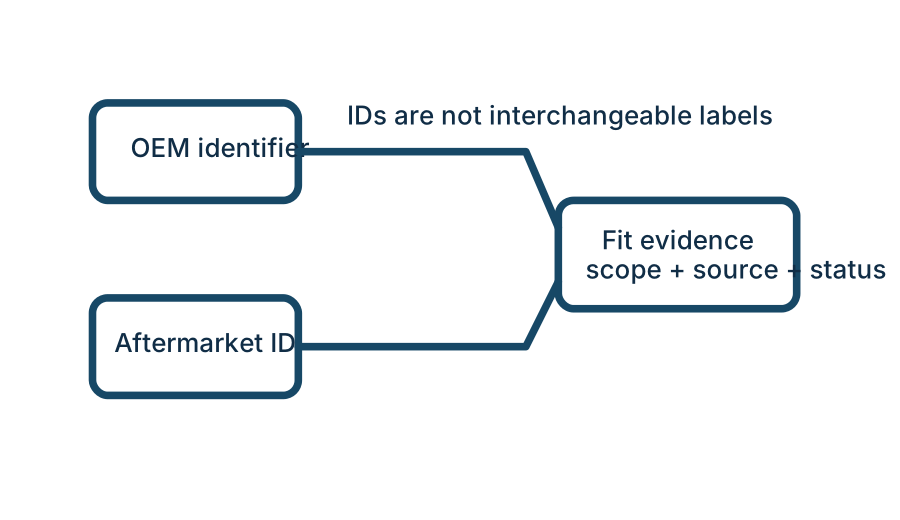
Original provenance diagram: identifier systems and fit evidence are separate questions. How to read an identifier safely Ask who assigned the identifier: manufacturer, authorized service channel, specialist seller, or generic marketplace seller. Keep OEM part number and aftermarket part number as separate fields. Never relabel a specialist code as OEM. Check whether the source maps the identifier to a collection, exact model/style, size, side, revision or production window. Read the compatibility status. A precise-looking code can still be LIKELY or UNVERIFIED. Check explicit non-fit records for the same code before ordering. Accepted database examples VERIFIED OEM example: Briggs & Riley ACC-5196-4 The accepted compatibility data OEM field carries ACC-5196-4 with published @work/Baseline scopes.
What it proves: The manufacturer identifier and its stated scope.
What it does not prove: It does not make visually similar generic foot kits equivalent.
Open compatibility record → VERIFIED Aftermarket/specialist example: HW1075A accepted compatibility data stores HW1075A in the aftermarket field for DELSEY Helium Aero 19/21-inch spinner hardware based on specialist mapping.
What it proves: A source-backed specialist identifier and fit scope.
What it does not prove: It is not presented as an OEM DELSEY part number.
Open compatibility record → DOES_NOT_FIT Same aftermarket code, wrong size: HW1075A on 25/29-inch Helium Aero The negative record preserves a wrong-size/interface conflict.
What it proves: That the code must not be generalized across size groups.
What it does not prove: A known aftermarket code is not universal within a collection.
Open compatibility record → LIKELY Generic aftermarket B001 carry handle B001 is a measurement-led candidate with a dense geometry signature.
What it proves: The seller identifier and candidate geometry.
What it does not prove: No exact luggage model crosswalk is asserted; dimensions alone do not create VERIFIED fit.
Open compatibility record → Do not “upgrade” provenance: a specialist mapping can be excellent evidence and still remain an aftermarket/specialist identifier. The database keeps that distinction so users can judge the claim correctly.
Browse part identifiers →