Problem-solving guide
Replace the wheel or the whole wheel housing?
Use failure location, axle condition, housing damage, position and source evidence to decide whether to identify the wheel alone or the complete housing/assembly.
People-first rule: Start with the failure or identification question, then collect evidence. Do not shop by appearance first and work backward toward a fit claim.
Core user job: Decide which component actually needs identification before ordering.
Fast decision: wheel only or complete housing?
| What you observe | Identify first | Reason |
|---|---|---|
| Tread is flat, split or noisy, but housing is solid and axle area is undamaged | Wheel + axle/bearing details | The visible wear may be confined to the rolling wheel. |
| Housing is cracked, distorted, loose at the shell, or the pivot/base is damaged | Complete housing/assembly | A correct wheel cannot repair a damaged mounting structure. |
| Wheel is missing and axle/fastener stack is unknown | Housing/assembly plus original hardware evidence | You need to know what retains the wheel before assuming a wheel-only replacement. |
| One side/corner differs from the others | Position-specific assembly | Left/right or corner mapping may use different part IDs. |
Why the distinction matters
A luggage “wheel” can mean three different things in parts catalogs: the rolling wheel by itself, a fixed wheel housing that carries the axle, or a spinner/corner assembly that includes a pivoting base. Ordering by the visible round wheel can therefore miss the component that actually attaches to the suitcase.
Use this guide to decide what to identify. It is not a repair instruction and it does not assume every wheel is designed to be separated from its housing.
Identification workflow
- Record the suitcase identity first. Photograph or transcribe the brand, collection, style/product ID and any production/revision marker.
- Locate the failure. Is the wear in the tread/bearing, the axle, the fixed housing, the spinner swivel/base, or the shell attachment?
- Record position. For four-wheel luggage, keep the viewpoint consistent. For two-wheel luggage, record left/right from a defined orientation.
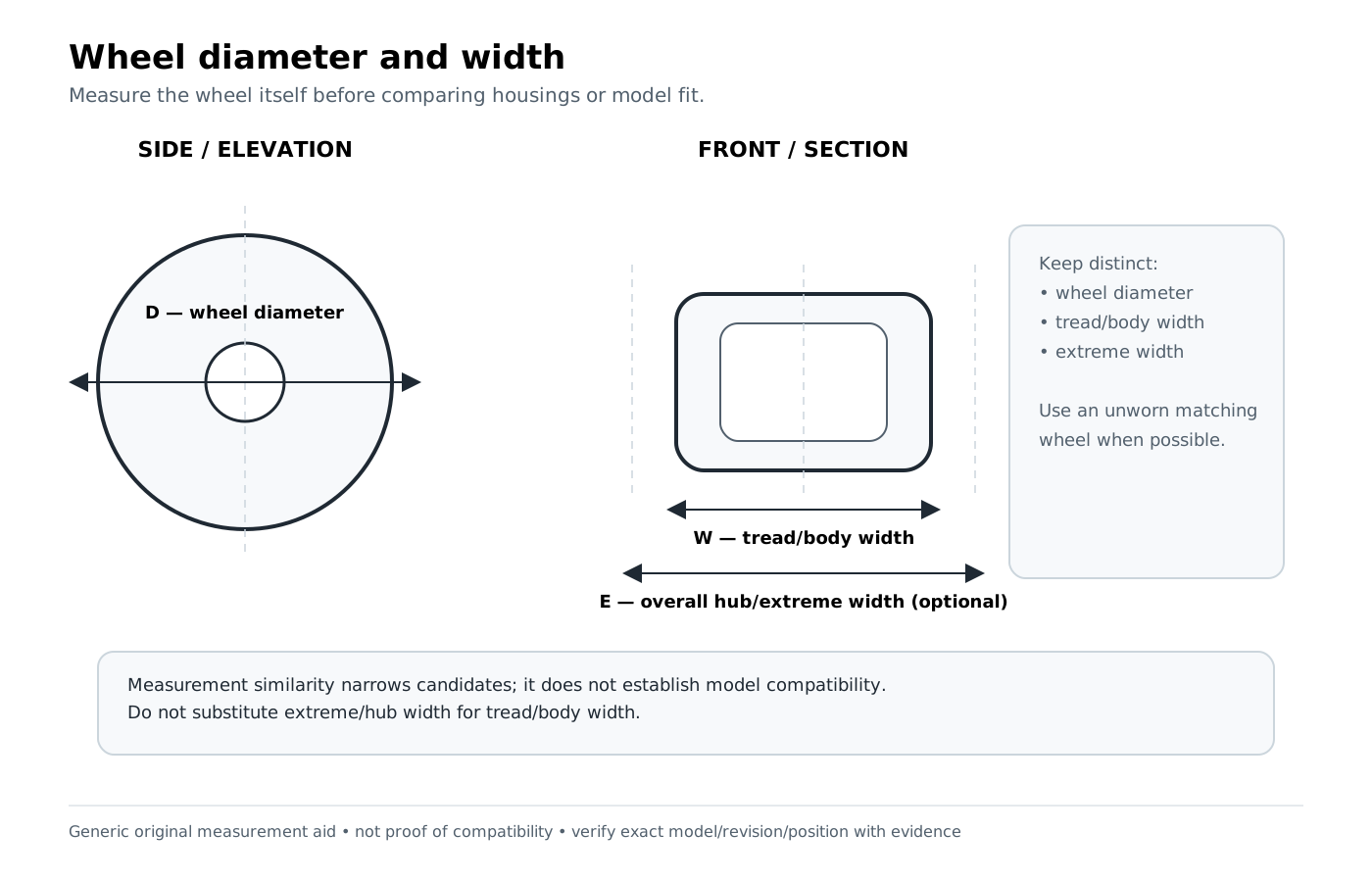
- Only then measure. For a wheel: diameter, width, bore/axle and clearance. For a housing: envelope, recess, fixing count and hole pattern.
- Search exact identifiers. Prefer manufacturer style and part IDs. Use geometry to reject candidates, not to manufacture certainty.

Measurement and label checklist
- Suitcase style/product ID and collection
- Wheel system: fixed/inline or swivel spinner
- Position: left/right and, for spinners, front/rear
- Wheel diameter and width
- Axle/bore and visible retaining hardware
- Housing/base width, height and depth; recess clearance
- Fixing count and hole-to-hole spacing
- Any OEM/service part number molded, labeled or documented
Common misidentification patterns
- Buying a wheel because the tread looks identical while the housing is actually broken.
- Buying a complete assembly when an exact wheel-only OEM part exists.
- Assuming opposite-side housings are mirrored but interchangeable.
- Assuming one wheel diameter implies one housing family.
- Ignoring missing washers, bearings, axle sleeves or covers that are part of the original stack.
Accepted database examples
| Accepted database example | What it teaches | State |
|---|---|---|
| Travelpro P40718W1501 wheel for Crew VersaPack Rollaboard styles | The official catalog maps one wheel SKU to both wheel positions; the wheel itself is a separate identification target from the housing. | VERIFIED |
| P40718W0101 left housing vs P40718W0401 right housing | Left and right housings have distinct official IDs even though the same wheel SKU is used. A damaged housing therefore changes what you need to identify. | VERIFIED |
| Generic L-2326 wheel/housing geometry | Published wheel, housing and hole-spacing dimensions can narrow candidates, but no authoritative suitcase-model crosswalk is present. | UNVERIFIED |
Boundary: Wheel dimensions can help identify a wheel candidate, but matching diameter or appearance alone does not prove that the axle stack, housing, position or luggage model is compatible.