Problem-solving guide
Telescoping luggage handle won’t lock: identification and troubleshooting decision tree
Separate push-button, release-linkage, lock-pin, tube, stage and mounting symptoms before deciding whether the handle needs service or replacement identification.
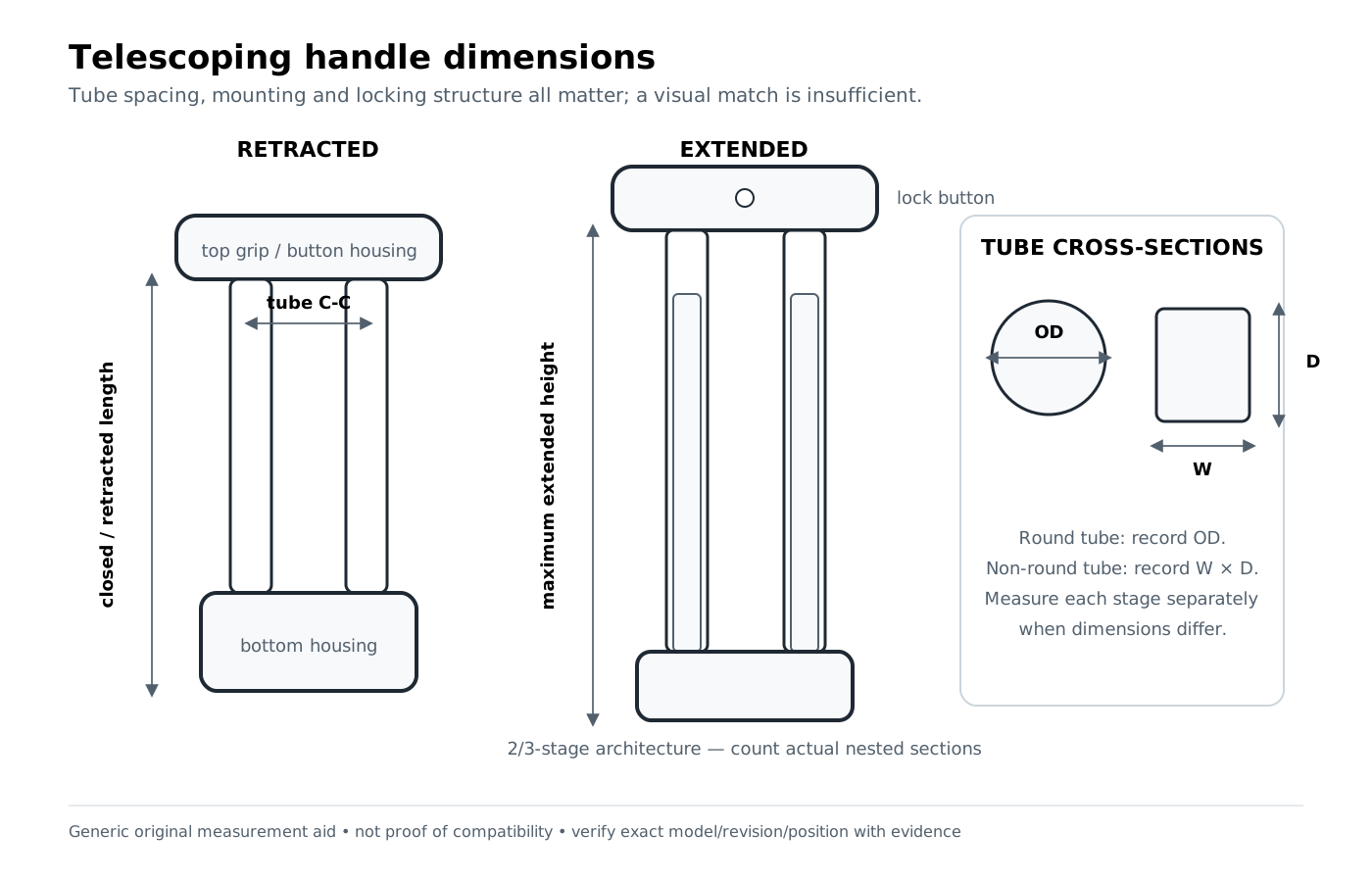
People-first rule: Start with the failure or identification question, then collect evidence. Do not shop by appearance first and work backward toward a fit claim.
Core user job: Localize the symptom without pretending the guide can diagnose an internal mechanism remotely.
Fast decision tree
| Observed behavior | Non-invasive identification question | Likely subsystem to inspect/describe |
|---|---|---|
| Button will not move | Is the top grip/button physically jammed or misaligned? | Button/grip interface; stop if force would be required. |
| Button moves but neither side releases | Does button travel feel normal, loose or disconnected? | Release linkage/cable/rod architecture. |
| One tube releases, the other stays locked | Is the asymmetry repeatable at the same stage? | One-side lock pin/linkage/tube alignment. |
| Handle extends but will not latch at one height | Does it latch at other designed stages? | Stage-specific lock position, tube deformation or internal lock issue. |
| Handle is loose at suitcase even when locked | Is movement at the tube stages or at the base mounting? | Mounting interface rather than lock button. |
| Tubes bind, twist or visibly bend | Does movement require force? | Tube/stage alignment; stop forcing the handle. |
Stop condition: If extension/retraction needs force, a tube is visibly bent/cracked, sharp edges are exposed, or accessing the mechanism would require drilling/cutting, stop. This page is an identification aid, not a brand-specific repair manual.
Why “won’t lock” is not one diagnosis
The same symptom can come from the top button, a release linkage, a lock pin, a tube stage, or the mounting system. A replacement handle is not automatically the first answer. Your first job is to describe where the behavior changes.
Non-invasive identification workflow
- Record the suitcase style/product ID and approximate production generation.
- Count telescoping stages and note which stage fails to latch.
- Without forcing, test whether both sides move symmetrically.
- Observe button travel: normal resistance, no movement, or unusually loose travel.
- Separate tube movement from base movement. A loose mounting plate is a different problem from an internal lock.
- Measure center distance, tube dimensions and closed length only after identifying the architecture.
- Use exact manufacturer/service mappings when available. If only a measurement candidate exists, preserve LIKELY/UNVERIFIED status.

Measurement and label checklist
- Brand, collection, style/product ID and revision/generation
- Stage count
- Tube center-to-center distance
- Tube width/depth or section descriptor
- Closed and extended length, when safely measurable
- Top grip/button architecture
- Which stage locks/does not lock
- Whether failure is one side, both sides, or at the mounting base
Common misdiagnoses
- Ordering a handle solely because another listing says “2-stage” or “3-stage.”
- Calling a loose base a lock failure.
- Assuming a center-distance match means the internal mechanism matches.
- Continuing to force a bent/binding handle and making identification harder.
- Using generic online repair steps as if every brand uses the same linkage.
Accepted database examples
| Accepted database example | Why it matters during troubleshooting | State |
|---|---|---|
| JX8183 telescoping handle assembly | Published as a 2/3-stage component with 134 mm center distance. That geometry identifies a component family candidate; it does not diagnose your internal lock fault. | LIKELY |
| JX8032 external handle | Uses a different 159 mm center distance and external/detachable architecture. Similar “pull handle” wording can hide a materially different mechanism. | LIKELY |
| Travelpro P4036H0002 | An exact OEM-style anchor in the database: a known 4-stage retractable handle kit for a specified FlightCrew 5 style. Exact identity is stronger than symptom similarity. | VERIFIED |
Boundary: Do not force, drill, cut or bypass a locking mechanism based on this guide. The decision tree is for non-invasive identification; hidden damage and brand-specific service procedures can change the correct repair.