Advanced telescoping-handle fit and revision checks
A dimension match is only the start. Before treating a telescoping handle as compatible, verify the mounting interface, release-button/lock mechanism, rail geometry, stage count, frame material and generation/revision scope.
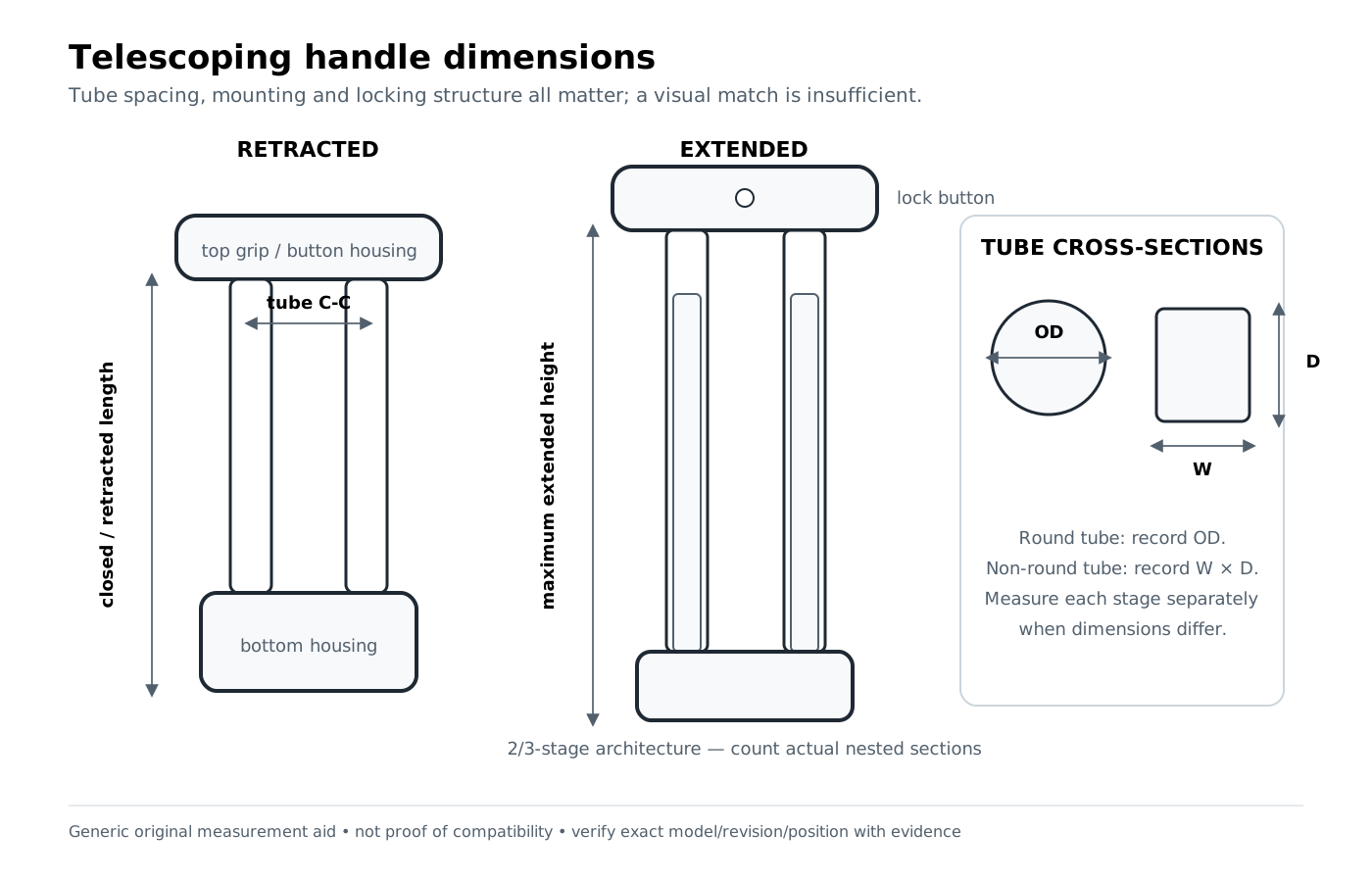
Preparation checklist
- Core dimensional measurements completed first.
- Exact product/style ID and any generation/production-window clue.
- Photos of lower mounts, rail cross-sections, grip/button, cable/rod linkage and frame interface.
- Stage count confirmed while the handle is fully extended.
- Any existing OEM/part number recorded without assuming supersession or cross-fit.
Advanced fit/revision workflow
- Mounting interface: compare brackets, screw/rivet pattern, locating tabs and how the assembly transfers load into the shell or frame.
- Release mechanism: identify whether the top button acts through rods, cables, internal pins or another mechanism. Button location alone is not enough.
- Rail geometry: compare tube cross-section, nesting order, offsets and guide blocks. Similar outer width can hide incompatible inner stages.
- Stage count: treat stage count as a structural identifier. A two-stage and five-stage system can belong to the same product family but require different assemblies.
- Generation/revision: check model style prefix, production window, “new generation” wording, frame material and any explicit exclusion.
- Conflict check: if a source says a handle damages a frame type or excludes a generation, stop. That evidence outweighs superficial geometry.
Worked examples from project data
Example 1 — stage count changes inside a legacy product family
Accepted Travelpro FlightCrew 3 records map a Rolling Overnighter style 3813-01 to a 5-stage telescoping handle assembly, while other FlightCrew 3 models use fewer stages. The 3813-01 relationship is VERIFIED through the official parts mapping.
What to learn: collection name and approximate width are not enough; stage count and exact style are part of the identification.
Example 2 — structural conflict overrides apparent similarity
For LuggageWorks Executive Series style 121A, the accepted data marks a stainless-steel Stealth telescoping handle as DOES_NOT_FIT because the manufacturer warns it will damage the Executive plastic frame.
What to learn: even a physically plausible assembly must be rejected when the frame/interface evidence says it is unsafe or incompatible.
Common mistakes
- Comparing only closed length and overall width.
- Ignoring the number of telescoping stages.
- Assuming the same brand/collection uses one handle across all generations.
- Matching a top grip while overlooking the lower frame bracket.
- Using “looks the same” to override an explicit manufacturer exclusion.
When measurements are not enough
Keep the result at candidate level when revision, mechanism or frame interface is unresolved. Explicit model/part mappings can support VERIFIED status. Explicit warnings, wrong-generation mappings or frame conflicts are DOES_NOT_FIT even if dimensions appear close.
How to interpret the evidence
Identification clue means something you can observe or measure—an ID, position, diameter, hole pattern, stage count or mounting detail. A clue narrows the search but does not prove fit. A candidate match means several clues align well enough to investigate. Source-backed compatibility requires explicit evidence within the stated product, revision, position and part scope.
VERIFIED
Explicit source-backed relationship within the stated scope.
LIKELY
Identifiers or measurements align, but explicit authoritative fit is incomplete.
UNVERIFIED
Candidate or component-presence evidence only; not a confirmed replacement fit.
DOES_NOT_FIT
Explicit conflict, exclusion, wrong position, wrong revision, or non-fit evidence.
Where to go next
Use Search once you have identifiers or measurements. You can also browse Products, Part IDs, or the relevant part-type directory.
Related guides: Core handle measurements · Find product/style ID · Search compatibility records
How this guide was prepared
This guide was prepared by the Luggage Parts Guide Editorial Team from source-tracked project data and original brand-neutral diagrams (telescoping-handle dimensions diagram). Measurements and identifiers are used as identification evidence, not as substitutes for explicit fit documentation. See the Editorial Policy and Methodology.
Reviewed: October 6, 2026