How to measure a luggage telescoping handle
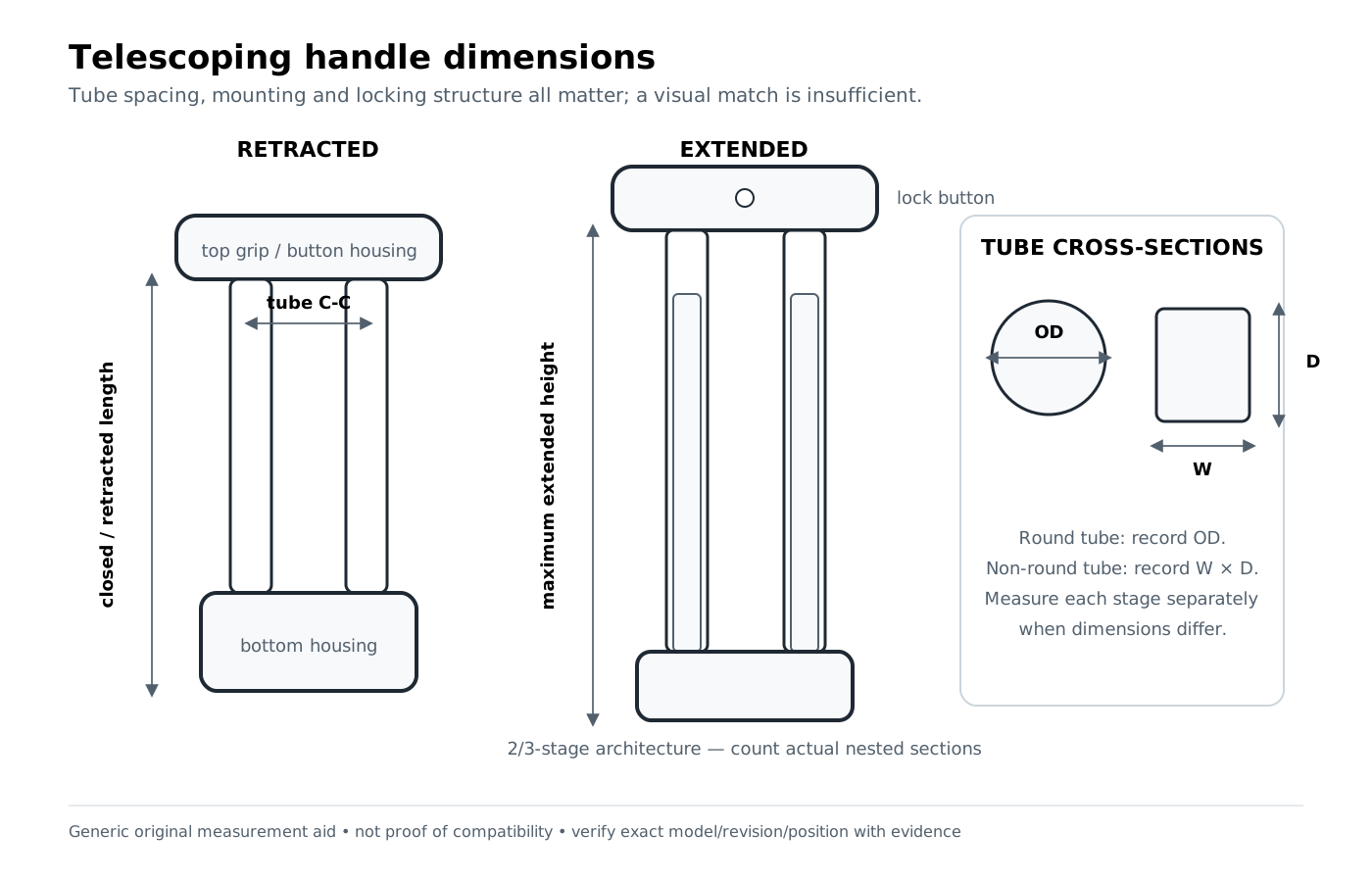
Measure the handle as a rail system. Record tube spacing, tube outside dimensions, rail/tube count, telescoping stage count, closed and extended geometry, and fixed mounting reference points.
Preparation checklist
- Product/style ID and generation/revision notes.
- Handle fully retracted, then fully extended, photographed straight-on.
- Calipers/ruler and a fixed shell reference point.
- Rail/tube count and stage count written down before disassembly.
- Bottom mounting points and top grip/lock-button arrangement photographed.
Step-by-step handle measurement
- Tube center spacing: measure center-to-center between the main rails/tubes. If center is hard to locate, record inside and outside distances plus tube width.
- Tube dimensions: record outside width/depth of each rail, not just the gap between them.
- Rail and stage count: distinguish two physical rails from the number of telescoping sections per rail. Two handles can share overall width but use different stage geometry.
- Retracted geometry: measure closed length from a repeatable mounting or housing reference—not an arbitrary shell edge.
- Extended geometry: measure full extension from the same reference and note the stop positions.
- Mounting reference points: record lower screw/hole spacing, brackets and any shell/frame interface that stays fixed when the rails move.
- Grip and release location: note grip width and button position as identifiers, then use the advanced guide before treating mechanism similarity as fit.
Worked examples from project data
Example 1 — 17-inch pull-handle variant
An accepted DELSEY Chatelet Air 2.0 pull-handle record documents a 444.5 mm closed length, 28.575 mm tube width, 193.675 mm overall width and 59 mm screw spacing. The specialist collection/variant mapping is VERIFIED.
Example 2 — similar interface, different closed length
A second Chatelet Air 2.0 variant records the same 28.575 mm tube width, 193.675 mm overall width and 59 mm screw spacing, but a longer 476.25 mm closed length. It is also VERIFIED within its stated variant scope.
What to learn: matching tube width and screw spacing does not make two length variants interchangeable.
Common mistakes
- Measuring overall shell height instead of handle closed length from a fixed reference.
- Calling “two rails” a “two-stage” handle.
- Recording overall handle width but not tube size and tube-center spacing.
- Ignoring lower brackets and mounting points.
- Assuming a grip that looks identical uses the same internal release mechanism.
When measurements are not enough
Once the dimensional signature is close, verify the mounting interface, release/lock system, frame material and revision. A dimension match can remain LIKELY or UNVERIFIED; an explicit generation or structural conflict must not be overridden.
How to interpret the evidence
Identification clue means something you can observe or measure—an ID, position, diameter, hole pattern, stage count or mounting detail. A clue narrows the search but does not prove fit. A candidate match means several clues align well enough to investigate. Source-backed compatibility requires explicit evidence within the stated product, revision, position and part scope.
VERIFIED
Explicit source-backed relationship within the stated scope.
LIKELY
Identifiers or measurements align, but explicit authoritative fit is incomplete.
UNVERIFIED
Candidate or component-presence evidence only; not a confirmed replacement fit.
DOES_NOT_FIT
Explicit conflict, exclusion, wrong position, wrong revision, or non-fit evidence.
Where to go next
Use Search once you have identifiers or measurements. You can also browse Products, Part IDs, or the relevant part-type directory.
Related guides: Advanced handle fit/revision workflow · Find your product/style ID · Browse all guides
How this guide was prepared
This guide was prepared by the Luggage Parts Guide Editorial Team from source-tracked project data and original brand-neutral diagrams (telescoping-handle dimensions diagram). Measurements and identifiers are used as identification evidence, not as substitutes for explicit fit documentation. See the Editorial Policy and Methodology.
Reviewed: October 6, 2026