How to measure luggage wheel housing geometry
Measure the complete housing in three dimensions and in relation to the suitcase shell. Record the external envelope, recess, mounting face, wheel projection, shell clearance and handed orientation before comparing candidates.

Preparation checklist
- Product/style ID, collection and revision notes.
- Declared suitcase viewpoint and corner/side position.
- Calipers or metric ruler, plus photos square to the mounting face.
- Existing screws/rivets kept in order so fixing count and stack are known.
- Measurements of the housing and the shell recess recorded separately.
Full housing workflow
- External envelope: record housing length, width and depth/height at the widest points.
- Shell recess: measure the pocket or cutout the housing sits in, including recess width/depth and any curved shell profile.
- Mounting face: photograph it square-on; record flat/curved surfaces, tabs, locating bosses and the number of fasteners.
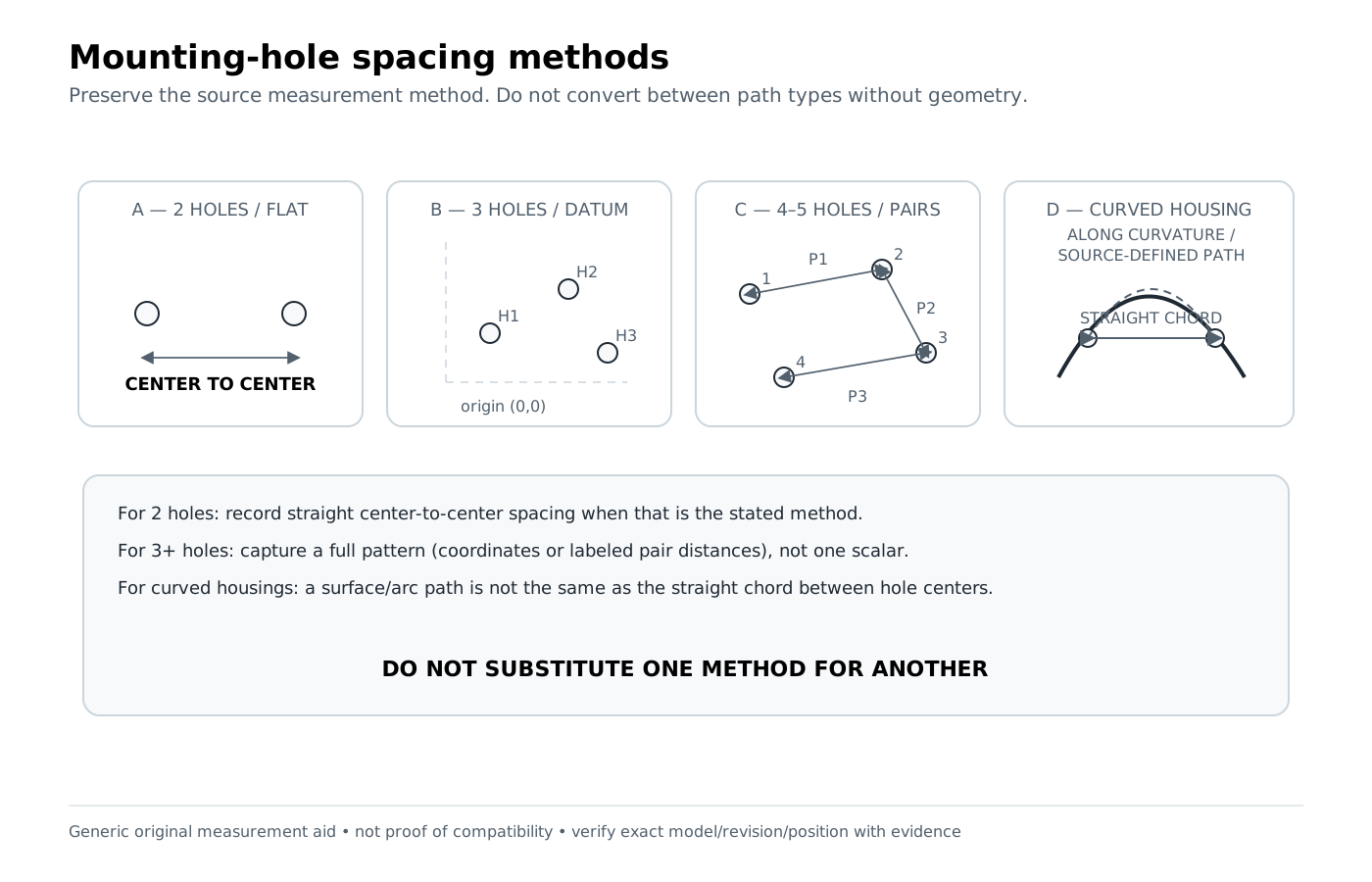
- Hole geometry: measure center-to-center distances. For three or more holes, record a repeatable coordinate/pair pattern rather than one diagonal guess.
- Projection: note how far the wheel/housing projects below and outside the shell. Projection affects ground clearance and whether the assembly collides during swivel.
- Shell clearance: check screw/rivet access, liner clearance and any reinforcement plate or molded pocket inside the case.
- Handedness/orientation: mark left/right or LF/LR/RF/RR before removal. Mirror-image housings can share dimensions while differing in mounting face or shell contour.
Worked examples from project data
Example 1 — envelope plus side selection
A DELSEY Chatelet Hard+ spinner assembly in the accepted data records a 50 mm wheel and housing dimensions of approximately 88.9 × 76.2 × 88.9 mm. The source also requires side selection across the four corner positions. The relationship is VERIFIED within that stated collection/scope.
What to learn: the housing envelope is useful, but orientation remains part of the fit definition.
Example 2 — detailed geometry cannot repair a revision conflict
A DELSEY Cruise spinner candidate records a 55 mm wheel, 76.2 mm overall housing height, and 19.05/33.02 mm hole-spacing measurements, with side selection required. It remains UNVERIFIED because the source conflicts between Cruise 2.0 and Cruise 3.0 naming.
What to learn: accurate measurements do not override unresolved generation identity.
Common mistakes
- Measuring only the wheel and assuming the housing follows.
- Recording outside dimensions but not the recessed shell pocket.
- Using edge-to-edge screw spacing instead of center-to-center spacing.
- Removing both sides at once and losing the left/right reference.
- Ignoring shell curvature, internal reinforcement or swivel sweep clearance.
When housing measurements are not enough
Stop at a candidate if the collection/revision is uncertain, the seller requires a side selection you cannot map, or the shell interface differs. If a source explicitly excludes a generation or position, record the conflict rather than “rounding” dimensions into a match.
How to interpret the evidence
Identification clue means something you can observe or measure—an ID, position, diameter, hole pattern, stage count or mounting detail. A clue narrows the search but does not prove fit. A candidate match means several clues align well enough to investigate. Source-backed compatibility requires explicit evidence within the stated product, revision, position and part scope.
VERIFIED
Explicit source-backed relationship within the stated scope.
LIKELY
Identifiers or measurements align, but explicit authoritative fit is incomplete.
UNVERIFIED
Candidate or component-presence evidence only; not a confirmed replacement fit.
DOES_NOT_FIT
Explicit conflict, exclusion, wrong position, wrong revision, or non-fit evidence.
Where to go next
Use Search once you have identifiers or measurements. You can also browse Products, Part IDs, or the relevant part-type directory.
Related guides: Mounting-pattern checklist · Measure the wheel itself · Advanced LF/LR/RF/RR positions
How this guide was prepared
This guide was prepared by the Luggage Parts Guide Editorial Team from source-tracked project data and original brand-neutral diagrams (housing dimensions/recess diagram, mounting-hole spacing diagram). Measurements and identifiers are used as identification evidence, not as substitutes for explicit fit documentation. See the Editorial Policy and Methodology.
Reviewed: October 6, 2026